British Isles and European Delights Trip 2025
A birthday treat turned into a useful opportunity to extend my practice and find new sources of inspiration.
In May 2025 I set sail on a cruise entitled British Isles and European Delights. An unusual itinerary leaving and returning to Liverpool sailing anticlockwise around Great Britain calling at St Peter Port in Guernsey, Honfleur in France, Ijmuiden for Amsterdam, then sailing up the North Sea to Shetland and Orkney before heading south back Liverpool. It was a treat for a significant birthday that fell during the voyage, and that was the main reason I chose it. But the thing about being an artist is you are always working to some extent, and it turned into a useful and productive trip. I treat these trips as mini residencies and always try to look for new relevant imagery for my work and I am glad to say this trip was no exception.
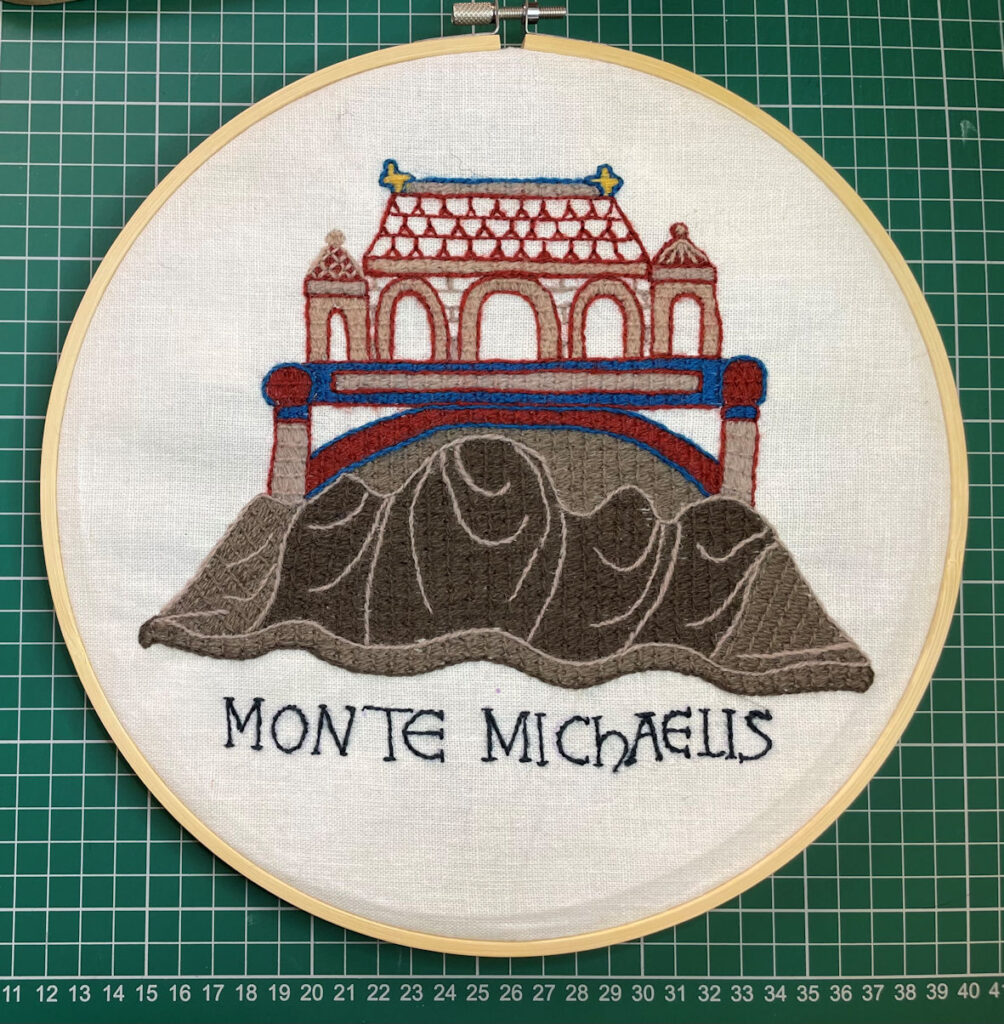
My version of Monte St Michel from the Bayeux Tapestry
The main surprise was pre-departure as I saw the opportunity to visit Bayeux, the tapestry and cathedral in an excursion from Honfleur. As a textile artist I’ve always been curious about the Bayeux Tapestry, which is, of course, an embroidery. The techniques used to make the large blocks of colour have always intrigued me. So, me being me, I spent the few weeks leading up to the trip learning how to do that characteristic Bayeux Stitch. This was facilitated by the fab book Bayeux Stitch by Tanya Bentham. I completed an exercise from the book, then had a go designing my own example using an image from screen shots of a very good online version of the original.
Pleased with my progress and coinciding with a project from the artist group I belong to I began to wonder about the possibility of sewing something on the ship. The evenweave fabric and woollen threads did not need the magnifying glass/light I use at home and I could probably manage with just an embroidery hoop without the stand I normally use to hold the fabric. I’d need to have the bare bones of a design marked up on the fabric, and ensure I had enough wool, but it might be doable. I hummed and hawed about it as the time to start packing drew near and I’m pleased to say I decided to take the sewing (fabric, threads, hoop, scissors, and other bits and bobs) and see how it went. One thing I was sure about, lighting in cabins is never good enough to sew by which meant I would have to sew in public, which would be interesting.
The first day from Liverpool was a sea day so I was able to find a well-lit place to sew with a clean normal height table, good light and a view out of the window. And from then on, most days I would sit and sew for at least a few hours listening to audio books looking out of the window to the sea and having occasional chats with passengers walking past. It was very satisfying.
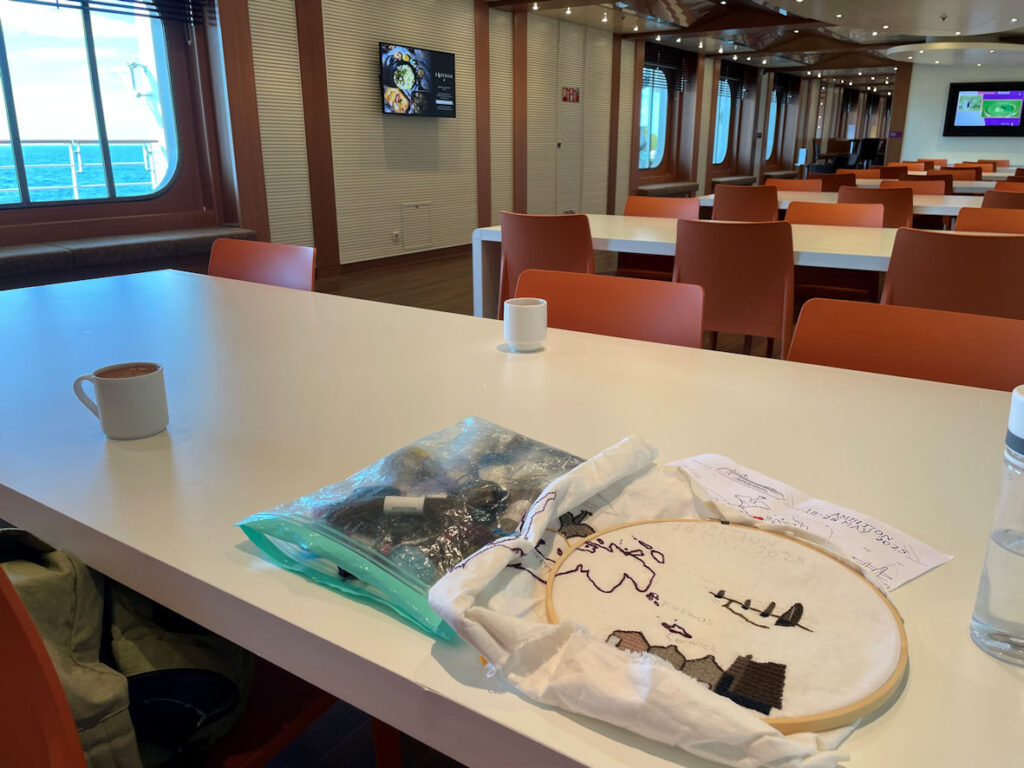
Location on the Ship where I did most of my sewing
My experience learning Bayeux stitch meant that on the trip to see the tapestry I had a much greater appreciation of what I was looking at and whilst I was sewing I felt a link to the women who had sewn it nearly a thousand years ago. I even bought some lovely wool at the little Broderie shop in Bayeux that had been recommended to me by people online. It was also interesting to visit the beautiful cathedral, where the tapestry was originally hung, with wonderful architecture and white Caen limestone from the nearby town we passed through on our rainy drive there.
There were several other useful stops on the trip. The Maritime Museum in Amsterdam has been on my radar (or should that be sonar?) for a long time because the Dutch had a significant arctic whaling heritage and I knew there was a Whaling Gallery at the museum. A coach from Ijmuiden took us to near the main Amsterdam station and it was a short walk over bridges and past numerous waterways to the museum. The Whaling Gallery was more comprehensive than I expected and there were some other galleries with useful collections all of which I duly photographed for future reference. The café was good too with a choice of seating with either views out over the canal basin the museum is situated on/in or out in the central court covered by a glass lattice of a windrose pattern found in early maritime charts. I have already started working up ideas from the set of Delft plates depicting whaling scenes on display there.
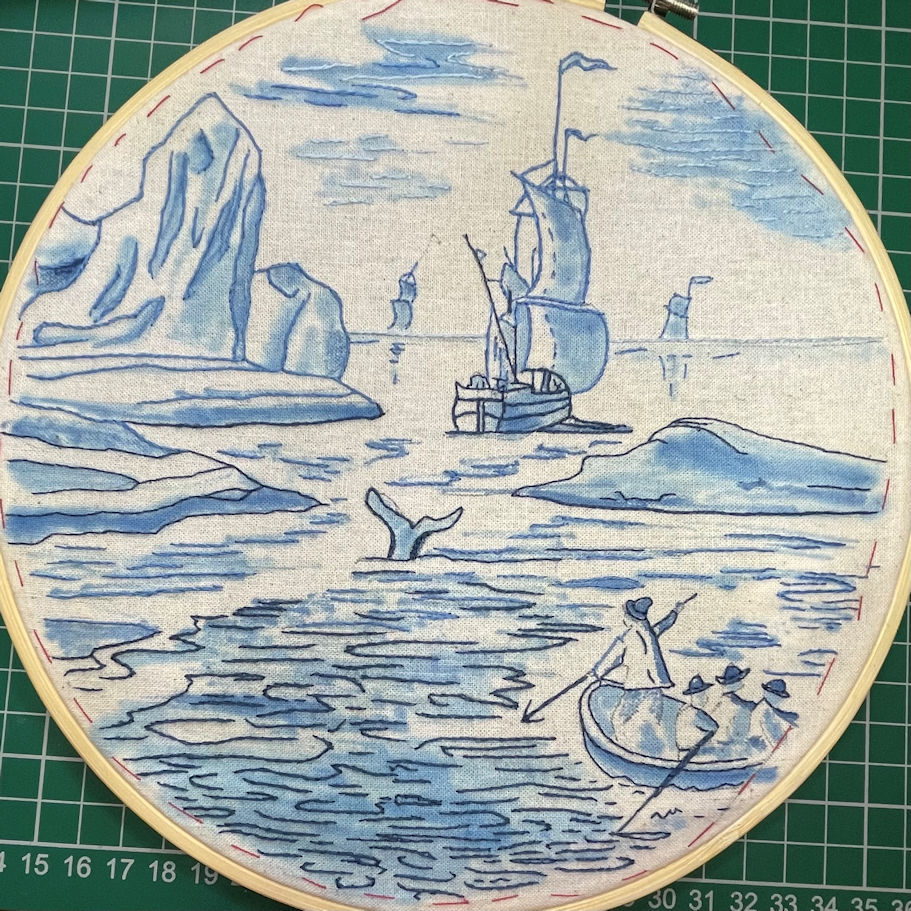
Embroidery inspired by whaling plate at the Dutch Maritime Museum
The big disappointment of the trip was that bad weather stopped us calling at Shetland and I missed my appointment to chat to the curators at the Shetland Museum and Archive. But I made it to the Stromness Museum in Orkney and saw their lovely collection of whaling objects and documents as well as interesting maritime charts and other displays.
The loss of the Shetland stop was compensated to some extent by a stop at Douglas. I’d never been to the Isle of Man before and had a fascinating time in the Manx Museum. It was TT practice week too and the museum gallery dedicated to motorbike racing on the island was well attended by bikers when I was there. Between these ports of call and sea days I sat in my corner and sewed.
As the design for my embroidery was based on the outline of the British Isles and an image from each of our ports of call. There was, therefore, a bit of squishing to get Douglas and a relevant image in as a last minute addition. Irritatingly I had beautifully sewn the Shetland Museum and Archive before the stop was cancelled, but it does highlight that the embroidery was done in real time. I didn’t manage to complete it on the voyage but made sure it was finished within a couple of weeks of returning home and I’m pretty pleased with the result. It is a lovely souvenir of my 60th birthday.
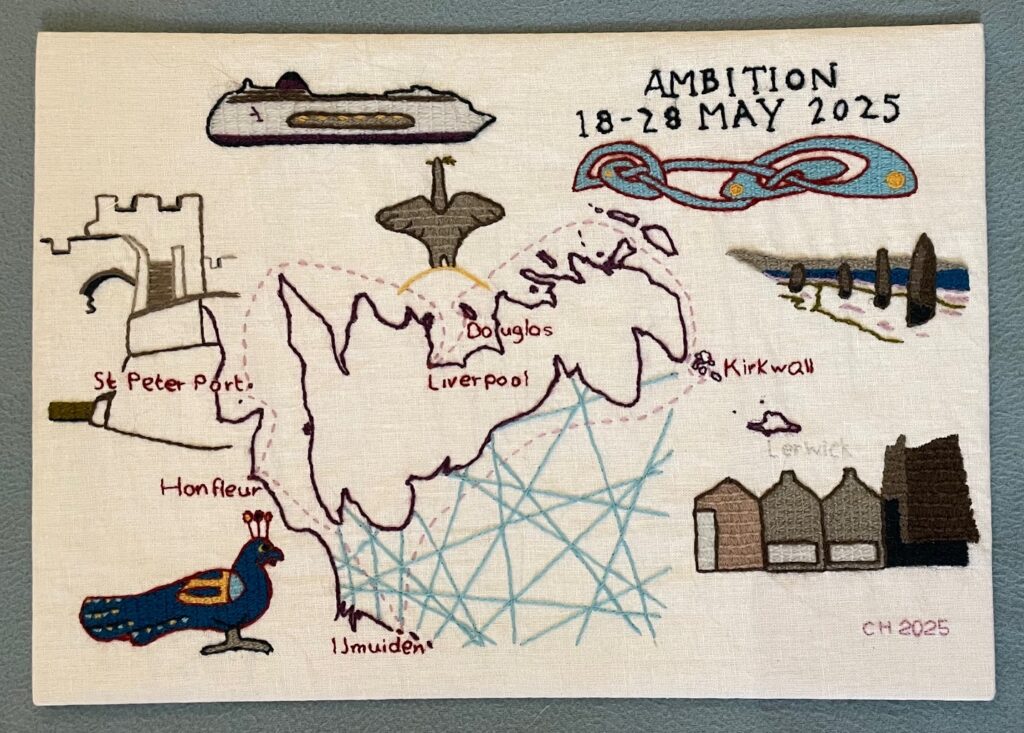
Finished embroidery showing locations and route